YouthCare4Planet on Earth Day: the Tunisian youth that acts, creates, and transforms
Coopération pour le développement des pays émergents

منشور في22-04-2026.
أضيفت في22 avril 2026
 In the framework of the Youth Creative Contest, we are launching a series of articles highlighting inspiring environmental initiatives led by young creators from across the Mediterranean. This first article, released on the occasion of Earth Day, puts the spotlight on how young people from different regions of Tunisia are turning ideas into action to protect our planet and drive meaningful change through creativity, innovation, and engagement.
Initiatives from across the territories
In the south-east of Tunisia, Gabès, a coastal region along the Mediterranean Sea, is characterized by the coexistence of a fragile oasis heritage and a strong industrial presence, making it particularly exposed to environmental challenges.
In this context, journalist Karim Ltifi, originally from El Hamma, conducts an in-depth investigation (available in Arabic) into the oases of Chatt Essalam and El Hamma, two essential ecosystems for local life in the governorate of Gabès. His work highlights the combined impacts of industrial activity, pollution, and water stress intensified by climate change. It also raises concerns about biodiversity loss, soil degradation, and the livelihoods of local communities, stressing the urgent need to protect these endangered natural spaces.
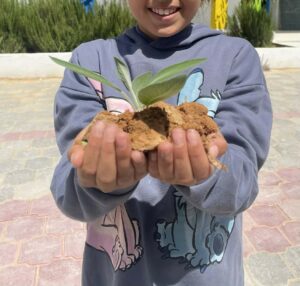
In the center of the country, Sidi Bouzid, an inland agricultural region characterized by rural landscapes and a key role in national agricultural production, inspires a sensitive and symbolic initiative. Mayssa Barhoumi, originally from the region, shares a photograph titled “Plant a Seed”, depicting a child holding a young plant. The image reflects hope, transmission, and the deep connection between humans and nature, reminding us that every small gesture contributes to environmental protection.
In the south-east, Médenine, a semi-arid region close to the desert and oasis areas, faces challenges linked to water scarcity and ecosystem vulnerability.
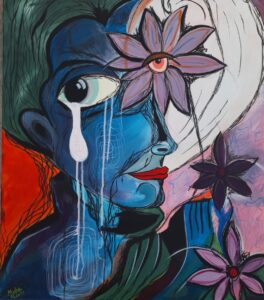
Artist Maha Abdelli, originally from the region, presents a symbolic visual artwork representing a human face between pain and hope. Through tears and flowers, she expresses both environmental degradation and the resilience of nature.
From Hammamet, in the north-east region of Nabeul, a coastal area known for both agriculture and tourism, and distinguished by its economic dynamism and agricultural richness where innovative initiatives continue to emerge in response to climate challenges, journalist Sonia Khamissi highlights, through a report published on Achahednews, an initiative on dragon fruit cultivation, a pioneering project in Tunisia. This initiative showcases innovative agricultural practices that are more water-efficient and better adapted to climate change, while promoting more sustainable and resilient farming models in the region.
Another contribution from the same region further illustrates how local actors are responding to climate challenges, this time by addressing the urgent issue of coastal erosion.
Through a photo story and short article (available in Arabic), Rabiaa Chalghoum highlights how marine erosion has become one of the most pressing environmental threats facing Hammamet’s coastline. Over the years, beaches that once stretched widely have significantly narrowed, with some areas losing large amounts of sand. This change is driven by a combination of factors, including rising sea levels linked to climate change, as well as human activities such as construction too close to the coast line, which disrupts the natural balance of sediment.
This phenomenon is not only an environmental concern but also an economic and social one. As a major tourist destination, Hammamet depends heavily on the health and beauty of its beaches. Coastal erosion therefore threatens tourism, local infrastructure, and marine ecosystems all at once, making it a complex and urgent challenge.
What stands out in this contribution is the strong role of civil society. Local organizations are actively working to raise awareness among citizens, especially young people, through workshops, educational programs, and media campaigns. These initiatives aim to build a culture of environmental responsibility and encourage community involvement in protecting coastal areas.
In parallel, practical solutions are being promoted. These includeplanting coastal vegetation to stabilize sand and reduce erosion, protecting dunes, and limiting pollution. Civil society groups also collaborate with public authorities by supporting coastal protection projects and monitoring illegal activities such as unauthorized construction along the coast line.
In the east-central region, Sfax, a major industrial and economic hub, is a highly urbanized area facing significant environmental challenges. Artist Noomen Noomen presents the video “Earth is Home”, a reflection on the impact of human activity on the environment and the temporary reduction of pollution during lockdown periods, reminding us of the fragility of our balance with the planet.
Finally, in Tunis, the capital city and national center for administration, economy, and innovation, several structural initiatives are emerging in support of the ecological transition. Dorra Fadhloun presents GreenTech Tunisia, a program supporting startups engaged in green transition across renewable energy, water management, waste, and sustainable agriculture. The article and video can be accessed here!
In the same spirit, Tunisian researcher Marwa Ben Amor is leading the OleaRevive project, an innovative initiative that reimagines olive by-products through a circular economy approach. By applying sustainable valorization techniques, the project transforms what is typically considered agricultural waste into high-value resources with significant economic, environmental, and industrial potential, contributing to more resilient and sustainable agri-food systems.
Youth that inspires change
From rural inland areas to coastal cities, from agricultural landscapes to urban centers, these initiatives reflect a Tunisian youth that is engaged, creative, and deeply aware of today’s environmental challenges.
They remind us that ecological transition is also built locally, through ideas, actions, and community-driven projects.
The Youth Creative Contest remains open, inviting young people to continue sharing their initiatives to collectively build a more sustainable future.